The Manifesto for Agile Software Development was created by 17 software developers in Snowbird, Utah in 2001. The short document defines four core paired values created by those completing the work to guide flexible, human-centric software development. The manifesto does not imply that the right side of the sentence is not important, just that the left side should be valued more.
I am an Agile principle leader
Leadership
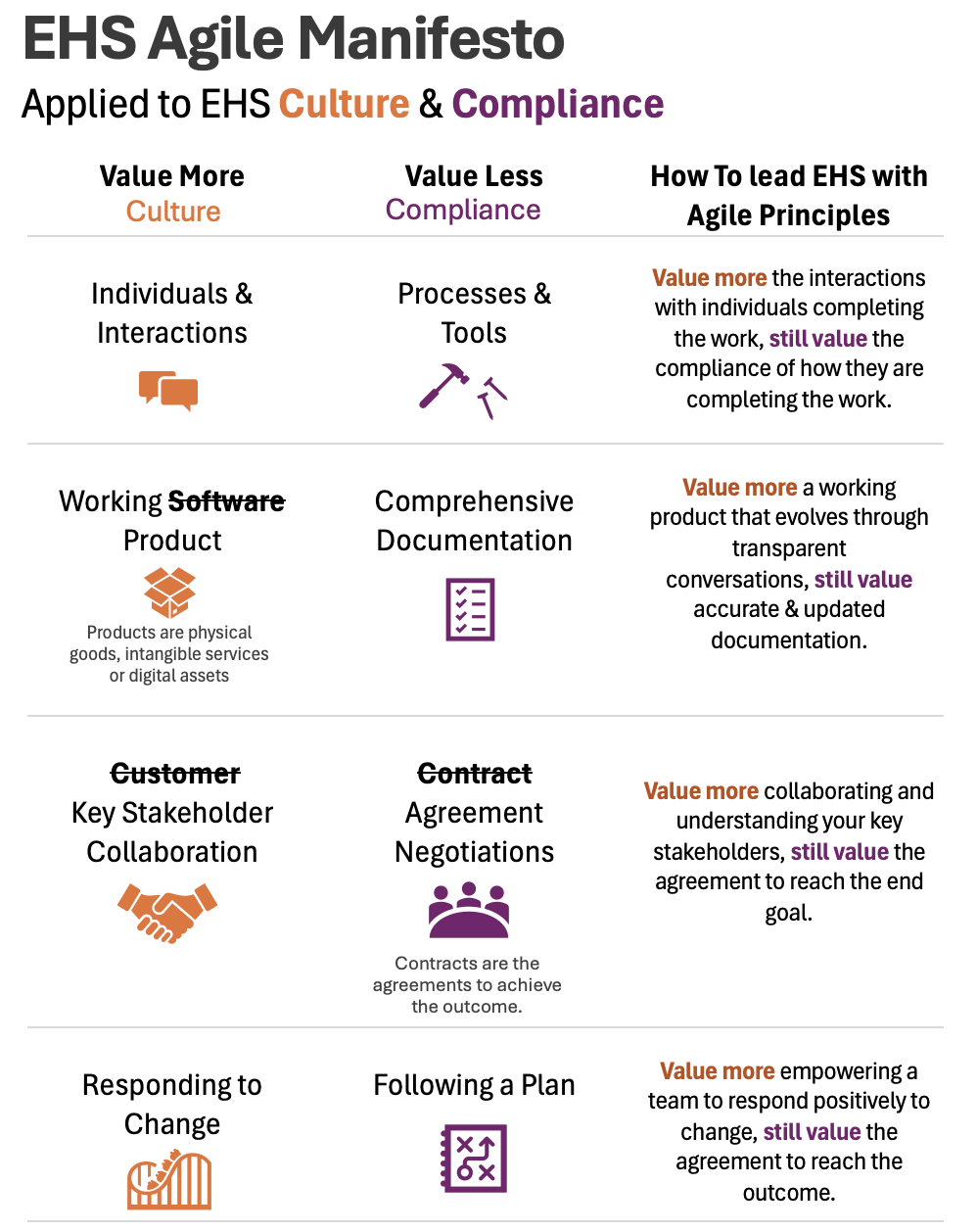
· Individuals and interactions over processes and tools
· Working software over comprehensive documentation
· Customer collaboration over contract negotiation
· Responding to change over following a plan
To adjust into an EHS leadership perspective, I would change only three words: Software to Product, Customer to Key Stakeholder and Contract to Agreement; to shape the lens of how Manufacturing professionals are walking the floor, maintaining continuous improvement and collaborating cross functionally.
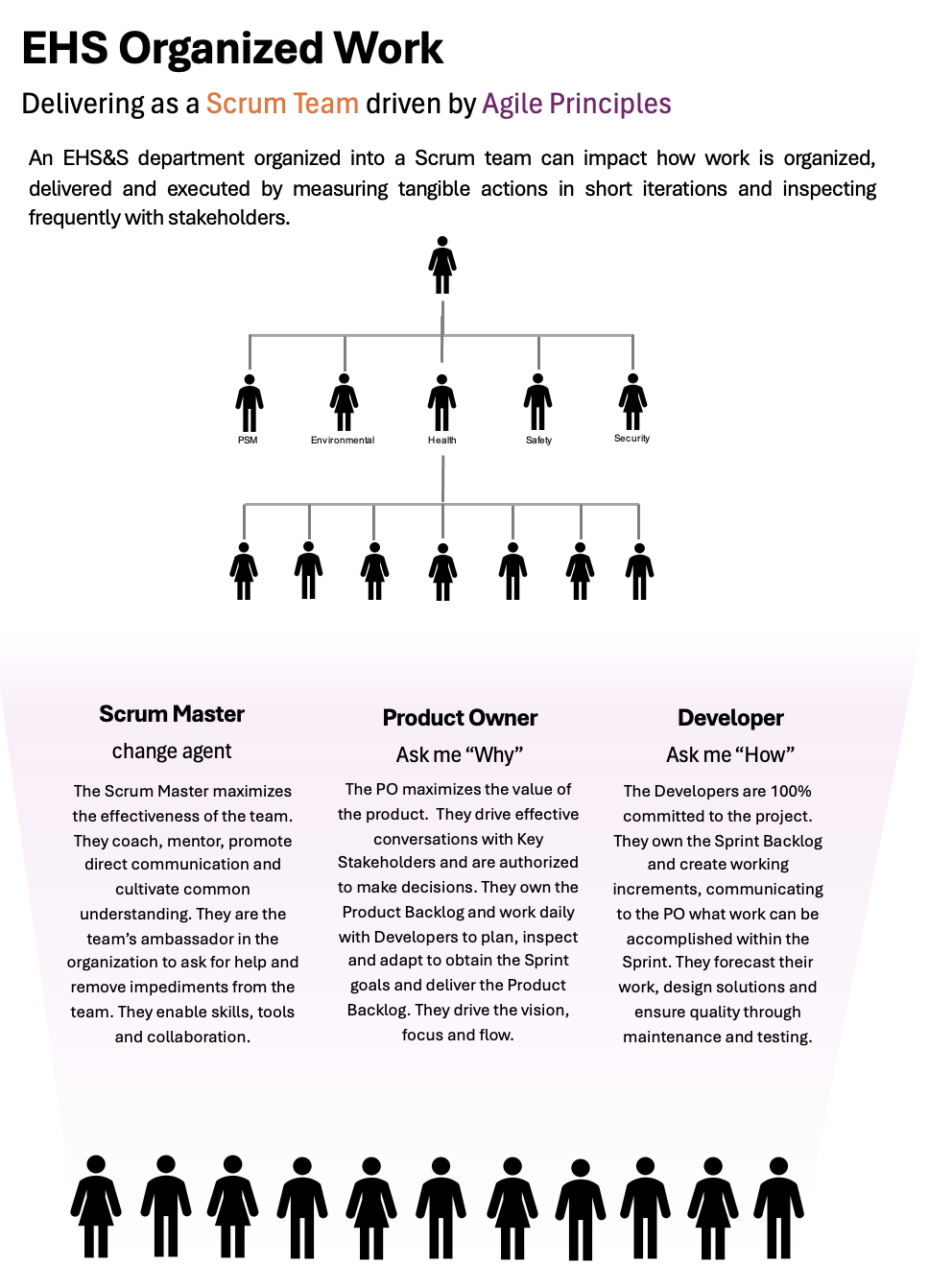
Scrum is a simple, team-based framework for solving complex problems. A Scrum team is self-managed and cross-functional, delivering tangible increments in short iterations called Sprints.
Scrum team members communicate directly and frequently with Key Stakeholders to build trust, avoid risk and evaluate the latest working product iteration.
An EHS&S department organized into a Scrum team can impact how work is organized, delivered and executed by measuring tangible actions in short iterations and inspecting frequently with stakeholders.
The Scrum framework does not focus on hierarchy but promotes opportunity to rotate EHS professionals into different assignments for delivering actions while remaining within their respective job role.
The chance for team members to lead and deliver for each other builds trust and camaraderie within the team, while allowing professionals to learn and contribute to different areas of overlapping EHS&S risk.
“A Scrum team thrives in trust, transparency and fast feedback. ”
Leadership
I am a hands-on change agent
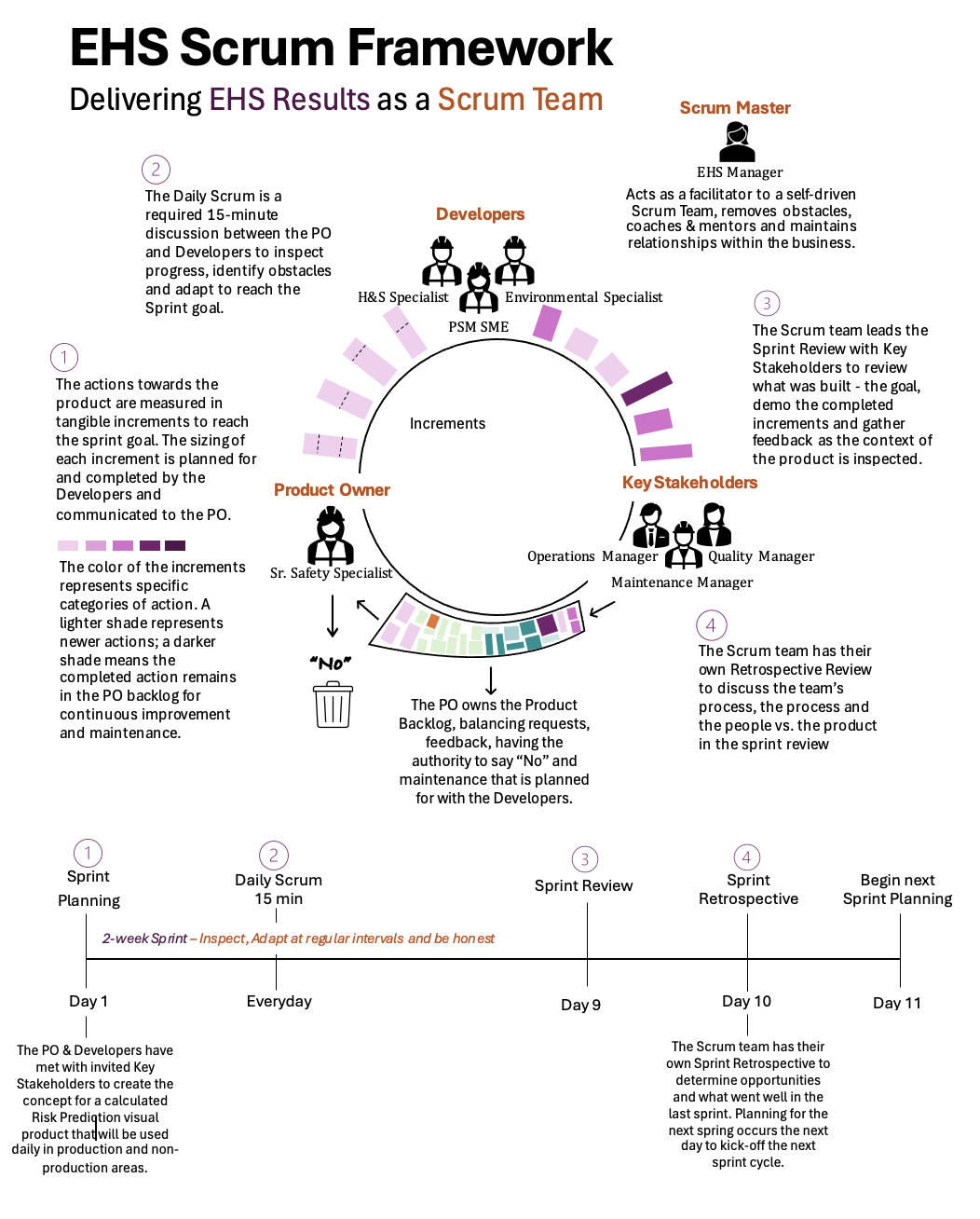
An EHS&S department organized into a Scrum team can impact how work is organized, delivered and executed by measuring tangible actions in short iterations and inspecting frequently with stakeholders.
The infographic to the right visualizes an EHS&S Scrum team’s stages of a 2-week Sprint cycle.
Leadership
I deliver results in a Scrum Framework
Step 1: Sprint Planning
The Product Owner (PO) & Developers have met with invited Key Stakeholders to build the vision and create a product goal. The PO manages the product backlog to break the work into actionable increments for the Developers to complete. The Developers size the actions needed to deliver at least one working increment per Sprint.
Step 2: Daily 15-minute Scrum
The time and place of the 15-minute Daily Scrum intended only for the Product Owner and Developers is coordinated. This time-boxed event is reserved for inspecting the tangibles in the Sprint Backlog towards the current Sprint goal.
Step 3: Sprint Review
The Scrum team leads the Sprint Review with Key Stakeholders to review what was built in the last Sprint, including but not limited to reviewing the product and sprint goals, providing a demonstration of the working increment(s) for the Sprint and gathering feedback from inspection of the current viable product.
Step 4: Sprint Retrospective
The Sprint Retrospective is a discussion for the Scrum team to unpack their effectiveness in the last sprint, focusing more on how the team worked together in comparison to the work that was actually completed. As a high-performing team, the expectation is exercise our team' psychological safety to reflect on our transparency, potential conflicts and shared accountability.
Leadership Experience
Collaborative Onsite Management & consulting to 40+ SC plants in North America
Emergency Preparedness
Maintaining and updating EAP through planning, local community support and semi-annual drill execution of fire, chemical release, severe weather, flooding, medical emergencies, spills and security response as an Incident Commander for all on-site employees driven with a voluntary EHS&S Pillar and HAZWOPER teams.
Root Cause Analysis
Led RCA investigations for potential SIF, Environmental and PSM near misses, all injury types, culinary and industrial water-related violations and exceedances. Also, supporting Operational loss RCAs to continuously improve the EHS&S of Operator SOPs.
Auditing
Boots on ground internal prep and external auditing participation for SQF, Food Defense Planning, Physical Security, Health & Safety, Environmental, Mechanical Integrity, Natural Gas, PSM and FM Global physical and human elements.
Third party Consulting
Air permitting requirements and points of emission for industrial processes, SPCC & PIPP annual review and update by licensed PE, P&ID drawings for new installations, auditing purposes, facility water mapping, fire protection system maintenance, PSM ammonia preventative maintenance and injection well installations for wastewater.
Sustainability & Yield Loss
Led two divisions of voluntary Green Team, hazardous waste and oil, floor drain management, wastewater sludge removal and physical recycling of cellulose casings, corrugate, plastics, paper, and spray cans. Partnered with QA to increase logarithm to extend shelf life of dumping brine to lagoon wastewater system.
CAPD & PDCA Execution
Check, Act, Plan, Do & Plan, Do, Check, Act 90-day business planning of operational pillars. Strategically identifying the EHS&S loss impacts into each pillar and influencing how other pillars can prevent and continuously improve their own metrics and KPIs that will directly or indirectly affect EHS&S losses.
Daily Safety, Environmental & Security Walks
GEMBA production line daily risk assessments, Hazardous & Universal waste accumulation inspections and manifest shipping, SPCC documented inspections, EGLE Stormwater and NPDES Wastewater inspections and preventative maintenance rounds, and updating physical SDS binders to coincide with accurate virtual database.
Worker’s Compensation
Managed all work-related injuries to prevent or report OSHA recordables and investigations, including emergency response, determining first aid and medical treatment care, onsite visits and discussions with local Occupational Health Clinic and local ER of company policies and expectations. Worked with HR & Operations to bring employees back for light-duty when applicable and effective for the business. l
Training, Interviewing & Team Building
Alchemy content training owner and delivery for all functions, including but not limited to supporting Continuous Improvement for Alchemy Coach hands-on validations. Exceptional welcome and delivery of new hire orientation for EHS&S and an alternate sub for delivering Quality Assurance HR materials, participant in interview process for selection of HR, EHS&S, QA, Engineering & Maintenance and Operations.
Hosted, organized and supported team building events, Material Handling OSHA authorized training, WMI HAZWOPER & Incident Commander, NFPA 70E Arc Flash training, EHS Pillar servant leadership breakfasts, site-wide holiday appreciation dinners and community secret Santa donations and blood drive events.
Fiscal Planning
Annual review of all EHS&S third party contracts and PE compliance documents. Hunted for acceptable EHS&S cost savings in PPE, annual, 3-year and 5-year PE compliance documentation and maps, 3rd party Security team requirements and voluntary in-house authorized trainers to eliminate external training parties.
Meaningful Networking
Colleague collaboration across industries, consulting firms and national organizations. As I continue to evolve my career and peer relationships to keep up to date with relevant policy, guidelines and effective ways of working to drive a zero-loss culture with a high performing team.